- Western Anatolia region
Western Anatolia is indeed a treasure trove of history, culture, and natural beauty
Western Anatolia: Turkey’s Hidden Heartland of History, Craft, and Natural Wonder
Beyond the sun-drenched beaches and bustling bazaars of Turkey’s coast lies a quieter, deeper side of the country—Western Anatolia. This sprawling inland region, stretching from the verdant shores of the Sea of Marmara to the serene lakes of the Taurus foothills, is where Turkey’s soul reveals itself in crumbling Byzantine ruins, artisan workshops, and steaming thermal springs.
Bursa and İznik: Where Empires Left Their Mark
The old Ottoman capital of Bursa wears its history with pride. Minarets pierce the sky above grand mosques like the Ulu Cami, where sunlight filters through twenty domes onto centuries-old calligraphy. Nearby, the Yeşil Türbe (Green Tomb) glows with its namesake tiles, a testament to the artistry that flourished under the sultans. The city’s Koza Han, once a hub of the Silk Road, still hums with traders selling shimmering fabrics, while the scent of Iskender kebap—thinly sliced lamb drenched in browned butter—drifts from open kitchens.
A short drive north, the tranquil town of İznik (ancient Nicaea) sits encircled by Byzantine walls. Here, the Ayasofya Mosque—once the church where the Nicene Creed was debated—stands as a silent witness to theological upheavals. But İznik’s true legacy is underfoot: its famed ceramic tiles, their cobalt blues and emerald greens adorning palaces from Istanbul to Isfahan.
Eskişehir and Kütahya: Cities of Stone and Fire
In Eskişehir, the ephemeral meets the eternal. The city is the global heart of meerschaum, a milky-white mineral carved into delicate pipes and figurines so fine they seem to glow from within. Stroll through Odunpazarı, where restored Ottoman houses now shelter cafes and galleries, their wooden balconies leaning conspiratorially over cobbled lanes.
Down the road, Kütahya’s kilns have burned for centuries, producing the vibrant tiles that define Turkish architecture. The city’s workshops, where artisans paint intricate floral motifs by hand, keep alive a tradition that once adorned the palaces of sultans. Climb to the Kütahya Castle at dusk, and the terracotta rooftops below seem to ripple like a living mosaic.
Afyonkarahisar: Opium, Cream, and Fortresses
The name Afyonkarahisar—"Opium Black Fortress"—hints at its dual identity. The region’s poppy fields, strictly regulated, yield the base for pharmaceuticals and the addictive Afyon kaymak, a clotted cream so rich it’s served with honey to cut the decadence. Above it all looms the Afyon Castle, its dark basalt walls a stark contrast to the rolling plains below.
Pamukkale and Afrodisias: Nature and Antiquity Entwined
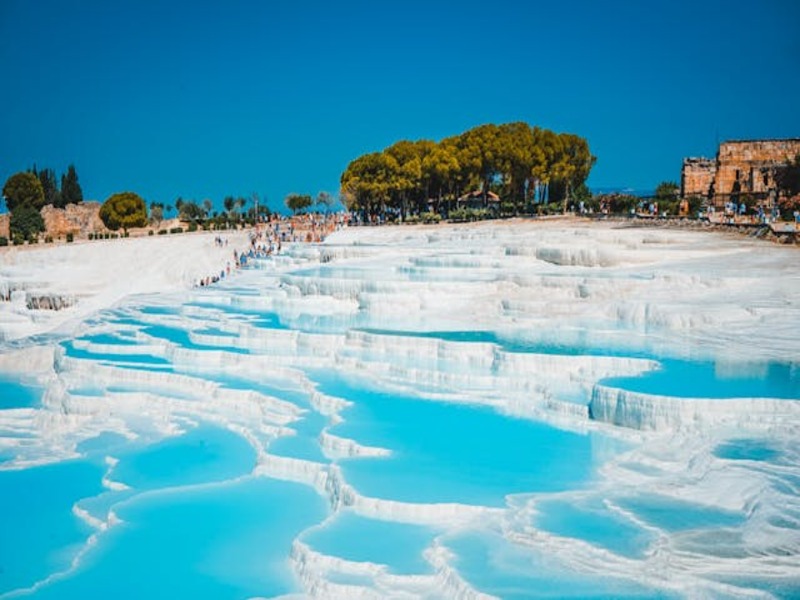
At Pamukkale, the earth itself seems to weep. Thermal waters, heavy with calcium, have cascaded down the mountainside for millennia, sculpting travertine terraces as white as bleached bone. Nearby, the ruins of Hierapolis—a Roman spa city—lie scattered among sun-bleached columns, their stillness broken only by the occasional echo of footsteps on marble.
An hour southwest, Afrodisias is a love letter in stone. Dedicated to Aphrodite, the goddess of beauty, its Temple of Aphrodite and colossal stadium (once seating 30,000) speak of a city that prized art and athletics in equal measure. The on-site museum’s statues, their marble faces still vivid with emotion, seem ready to step down from their pedestals.
Eğirdir: A Lake of Quiet Reflections
Finally, there is Lake Eğirdir, where the water mirrors the sky so perfectly it’s hard to tell where one ends and the other begins. On Yeşil Ada (Green Island), fishermen mend nets as apple orchards scent the air. Here, time moves at the pace of ripples lapping against stone piers—a gentle reminder that some of Turkey’s greatest treasures are found not in its crowds, but in its quiet corners.
The Undiscovered Anatolia
Western Anatolia is for those who travel to listen—to the tap of a meerschaum carver’s chisel, the call to prayer echoing off Roman theater walls, the whisper of wind through poppy fields. It’s a land where history isn’t confined to museums but lives in the hands of artisans, the steam of a thermal spring, the first bite of a pastry still warm from the oven. To explore here is to find the Turkey that exists beyond postcards—a place where the past is never truly past.