The Zeugma Mosaic Museum in Gaziantep
Gaziantep is famous not only for its world-renowned cuisine but also for being home to one of Anatolia's most impressive archaeological treasures. The Zeugma Mosaic Museum is one of the city's most important cultural attractions, housing extraordinary Roman-era mosaics, frescoes, sculptures, and architectural remains. However, the story of the Zeugma Mosaic Museum is about much more than works of art. Behind the museum lies a story involving the Euphrates River, the Roman Empire, an ancient trading city, a major dam project, and a race against time to rescue archaeological treasures. Many of the artifacts displayed in the museum today were rescued from the ancient city of Zeugma, where they were threatened by the rising waters of the Birecik Dam.
Where Is the Ancient City of Zeugma?
The ancient city of Zeugma was located near the town of Nizip in Gaziantep Province, on the banks of the Euphrates River. The city was founded in the 3rd century BC by Seleucus I Nicator, one of the generals of Alexander the Great. Originally known as Seleukeia on the Euphrates, the city quickly became an important commercial and strategic center thanks to its location on one of the major crossing points of the Euphrates. After coming under Roman rule, the city became known as Zeugma. The Greek word zeugma means “bridge,” “connection,” or “crossing.” Its strategic location on the Euphrates increased Zeugma's economic and military importance. The city reached great prosperity during the Roman period. The magnificent villas of wealthy Roman families, decorated with elaborate floor mosaics, are what made Zeugma famous around the world.
Why Was Part of Zeugma Submerged?
One of the most important turning points in the modern history of Zeugma was the construction of the Birecik Dam on the Euphrates River. When the dam was completed, the water level of the Euphrates rose. As a result, significant parts of the ancient city, particularly areas known as Lower Zeugma, were submerged. This created an enormous challenge for archaeologists. Once it became clear that parts of the ancient city would be flooded, extensive archaeological rescue excavations were launched. The goal was to save as many mosaics, frescoes, sculptures, and other archaeological remains as possible before the rising waters reached them. From the late 1990s onward, extensive excavations revealed numerous important discoveries. These excavations greatly expanded our understanding of Zeugma's wealth, culture, and daily life during the Roman period.
Mosaics Rescued from the Waters of the Euphrates
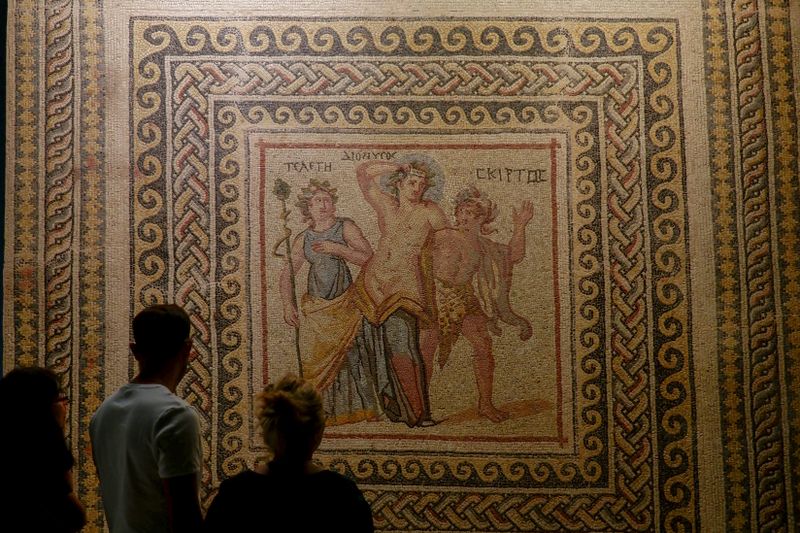
Among the most important discoveries made during the rescue excavations were the remains of the Villa of Poseidon and the Villa of Dionysus. The mosaics found on the floors of these villas demonstrate the extraordinary level reached by Roman mosaic art. Thousands of tiny pieces of stone were carefully arranged to create scenes depicting mythological stories, gods, animals, and human figures. But not all of Zeugma could be saved. When the dam began to retain water, parts of the ancient city and some of its structures were submerged beneath the Euphrates. For this reason, the remains that can be visited at Zeugma today represent only a surviving part of what was once a much larger ancient city.
The Most Remarkable Feature of the Zeugma Mosaics: Natural Stone
One of the most remarkable characteristics of the mosaics at the Zeugma Mosaic Museum is the material used to create them. The ancient Zeugma mosaics were made primarily from natural stones. Their colors were not created by painting the stones. Instead, the artists selected stones that naturally occurred in different colors and used them to create their compositions. The reds, yellows, browns, whites, grays, and various shades seen in the mosaics are largely the natural colors of the stones themselves. The artists cut these stones into extremely small pieces and carefully arranged them to create human faces, clothing, hair, animals, and mythological scenes. What makes the technique particularly impressive is that the artists did not simply place differently colored stones next to one another. By carefully controlling the color, size, shape, direction, and arrangement of each stone, they were able to create effects of light and shadow in faces, muscles, hair, and clothing. As a result, the mosaics can appear almost three-dimensional. When you look closely, you see thousands of tiny pieces of stone. Step back a few meters, however, and these individual pieces come together to form remarkably realistic human faces and figures. This is one of the most impressive aspects of Zeugma's ancient mosaic tradition.
The Gypsy Girl: An Optical Masterpiece in Mosaic Art
One of the most remarkable examples of this technique is the mosaic known as the Gypsy Girl. When you look at the face of the Gypsy Girl, you may feel that her eyes are following you. As you move to the right or left in front of the mosaic, her gaze appears to move with you. Of course, the figure itself does not move. This fascinating effect is created by the artist's sophisticated use of perspective, facial structure, and the precise arrangement of the stones. The effect often reminds visitors of the gaze of Leonardo da Vinci's Mona Lisa. The careful selection of naturally colored stones and their precise arrangement allowed an ancient artist, almost 2,000 years ago, to create an optical effect that can still surprise visitors today. For this reason, the Gypsy Girl is not simply a beautiful mosaic. It is also a remarkable demonstration of the technical sophistication of ancient mosaic art.
The Gypsy Girl Mosaic
The most famous work in the Zeugma Mosaic Museum is undoubtedly the Gypsy Girl Mosaic. With her mysterious gaze, the female figure seems to look directly at the visitor and has become the symbol of the museum. Her large hoop earrings, distinctive hair, and striking eyes immediately attract attention. There are different interpretations regarding the identity of the figure. Some scholars have associated it with a Maenad or with the cult of Dionysus. The name “Gypsy Girl” was given to the figure in modern times, inspired by its appearance. The most remarkable feature of the Gypsy Girl is undoubtedly her eyes. The slight turn of her head and the direction of her gaze create an extraordinary sense of liveliness. This is why the work is sometimes compared with Leonardo da Vinci's Mona Lisa.
The Mars Statue
Another important work in the museum is the bronze statue of Mars, the Roman god of war. The statue was discovered in 2000 during excavations at the Villa of Poseidon in Zeugma. Mars was one of the most important symbols of warfare and military power in Roman culture. The impressive design of the statue reflects Zeugma's strong connection with the Roman world. The presence of such sculptures alongside the mosaics also reminds us that Zeugma was much more than simply a center of mosaic production.
Why Are the Zeugma Mosaics So Important?
It would be a mistake to see the Zeugma mosaics simply as decorative works of art. They provide valuable information about life and culture in Roman society. The mosaics depict a wide range of subjects, including: Greek and Roman mythology The cult of Dionysus Gods and goddesses Heroes Animals Plants Scenes from daily life The lifestyle of the Roman elite What makes the Zeugma mosaics particularly remarkable is the extraordinary use of natural stone. Instead of relying on painted surfaces, ancient artists used the natural colors of stones and arranged them with remarkable precision. Different shades and carefully oriented pieces created a sense of light, shadow, depth, and movement. These works, created almost 2,000 years ago, continue to amaze visitors with their technical sophistication.
Walking Through a Roman Villa
There is one important point to keep in mind when visiting the museum: These mosaics were not originally created to be displayed in a museum. They decorated the floors of Roman villas, including dining rooms, courtyards, and other living spaces. The Dionysus scene you see on the museum floor, for example, was once part of the floor of a wealthy Roman family's home. People would have walked across it nearly 2,000 years ago.
The mosaics were also a reflection of the owner's wealth, cultural sophistication, and connection to the mythology and traditions of the Roman world. In this sense, visiting the Zeugma Mosaic Museum is not simply a visit to an art museum. It is a journey into the private world of Roman society nearly 2,000 years ago.
Why Should You Visit Zeugma?
The Zeugma Mosaic Museum is special for much more than the Gypsy Girl. Here, visitors can experience the grandeur of the Roman Empire, the history of the Euphrates River, the wealth of ancient Zeugma, the extraordinary art of natural-stone mosaics, and the modern struggle to preserve cultural heritage. The mosaics that once decorated the homes of people living along the Euphrates are now displayed in Gaziantep for visitors from around the world. Part of ancient Zeugma now lies beneath the waters of the Euphrates. Yet thanks to the enormous archaeological rescue efforts, a significant part of the city's story has survived. And perhaps one of the most fascinating aspects of the museum is this: without using painted colors, ancient artists transformed tiny pieces of naturally colored stone into remarkably lifelike, three-dimensional images and expressive human faces. When you visit the Zeugma Mosaic Museum, you are therefore not simply visiting a museum. You are discovering the story of a nearly 2,000-year-old civilization rescued from the waters of the Euphrates.
Last Modification : 9/17/2026 11:22:53 PM