Golden Apple
The Emperor’s Riddle and the Symbolism of the Golden Apple
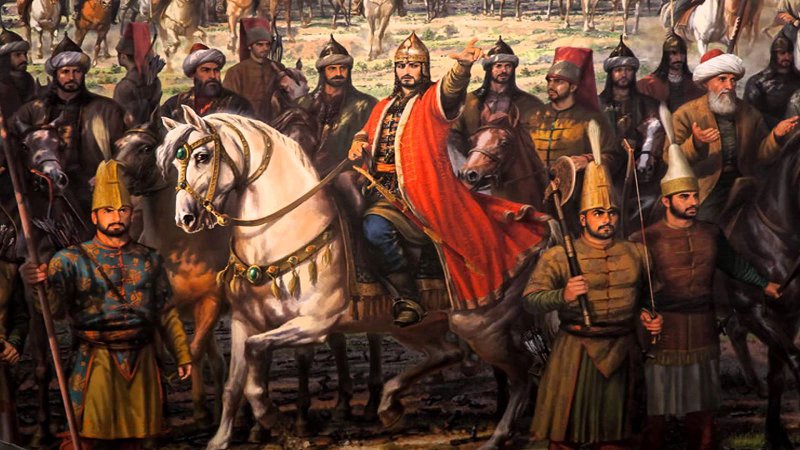
One day, the emperor ordered a large carpet to be spread before his courtiers and placed an apple in its center. He then posed a riddle: "Can any of you take this apple without stepping on the carpet?" As the gathered nobles debated how such a feat could be accomplished, the emperor himself strode forward. He stepped onto the carpet, picked up the apple, and then proceeded to roll up the carpet from one end, walking backward as he did so. The assembly finally understood the lesson. The emperor then restored the carpet to its original position and declared: "To slowly dismantle the infidel’s strength is better than seizing his land in a single stroke." His wisdom and the clever demonstration were met with great admiration.
After 1453, the Ottoman accession ceremony incorporated an apple motif—a universal symbol of sovereignty. Once the new Sultan was girded with the sword of state, the Janissaries would cry out, "We shall meet at the Red Apple!" This phrase encapsulated the Ottoman ambition to conquer the Christian world. The golden or red apple, however, had roots stretching back to antiquity. Legend holds that Alexander the Great possessed a golden apple, crafted from the tributes of conquered lands, which he held as if clasping the world itself.
Sultan Mehmed II was deeply familiar with the legends of Alexander, as well as the tales of Hannibal and Caesar, drawing from both Islamic and classical texts. A Greek copy of Arrian’s Life of Alexander still resides in the Topkapı Palace Library, part of the Sultan’s personal collection. The humanist scholar Lauro Quirini observed: "He desires to rule over all nations and be recognized as a second Alexander. It is for this reason that he has made it a habit to have Arrian’s account read to him daily." When he tired of Alexander, Italian courtiers in his service would instead read to him from the works of Herodotus, Livy, Quintus Curtius, and histories of popes and emperors. The Italian chronicler Giacomo Languschi noted that Mehmed sought to rival Alexander’s conquests—but with an inverted ambition: to forge a universal empire under a single faith and ruler, marching not from West to East, but from East to West.
The humanist scholar George of Trebizond and Pope Pius II both wrote letters to Mehmed, urging him to embrace Christianity. They argued that uniting his empire under the Christian faith would grant him glory surpassing that of Alexander, Caesar, or even Constantine. To immortalize Mehmed’s deeds, George even proposed writing a Latin biography, proclaiming that the Sultan’s achievements "would outshine even those of Alexander the Great." Though George never composed the work, a decade later, the historian Kritovoulos penned a Greek chronicle of Mehmed’s reign. In its dedication, he explained that he wrote in Greek so that the West—and all admirers of Hellenic tradition—might recognize that the Sultan’s accomplishments "were in every way equal to those of Alexander of Macedon."
Thus, the apple—once a simple riddle’s solution—became a potent emblem of imperial destiny, linking Mehmed’s ambitions to the legends of antiquity and the eternal pursuit of universal dominion.
Last Modification : 9/17/2026 11:24:54 PM