The History of Ancient Mesopotamia
Ancient Mesopotamia is widely regarded as one of the most important regions in human history. Located between the Tigris and Euphrates rivers, in what is today primarily Iraq and parts of Syria, Turkey, and Iran, Mesopotamia witnessed the emergence of some of the world's earliest cities, writing systems, legal traditions, and organized states. The name Mesopotamia comes from the ancient Greek words mesos (middle) and potamos (river), meaning "the land between the rivers." For thousands of years, different civilizations flourished in this fertile region. The Sumerians, Akkadians, Babylonians, and Assyrians developed sophisticated political systems, monumental architecture, mathematics, astronomy, literature, and religious traditions that influenced later societies throughout the ancient world. Mesopotamia was not a single empire or civilization. It was a cultural and geographical region in which different peoples built cities, competed for power, traded with distant lands, and contributed to the development of human civilization.
1. The Geography of Mesopotamia
Mesopotamia was situated between two major rivers: the Tigris and the Euphrates. Both rivers originate in the mountains of eastern Anatolia, in modern-day Turkey, and flow southeast toward the Persian Gulf. Their annual flooding deposited fertile soil across the surrounding plains, making agriculture possible in an otherwise relatively dry environment. However, farming in Mesopotamia required sophisticated irrigation systems. People constructed canals, reservoirs, and drainage networks to control water and distribute it to agricultural fields. This agricultural surplus allowed communities to grow beyond small villages and develop into permanent settlements and eventually major urban centers. The geographical location of Mesopotamia also encouraged trade. Its position connected Anatolia, the Iranian plateau, the Levant, the Arabian Peninsula, and the Persian Gulf. Mesopotamia became a crossroads of ancient commerce, cultural exchange, and migration.
2. The Sumerians: The First Great Urban Civilization
The Sumerians emerged in southern Mesopotamia during the fourth millennium BC. They established some of the earliest known cities in human history. Important Sumerian cities included: Uruk Ur Eridu Lagash Nippur Kish Among these, Uruk became one of the largest and most influential urban centers of the ancient world. The Invention of Writing One of the greatest achievements of the Sumerians was the development of writing around 3400–3200 BC. The earliest writing systems were primarily used for recording agricultural products, commercial transactions, taxation, and administrative activities. Over time, this system developed into cuneiform writing. Cuneiform was produced by pressing a reed stylus into soft clay tablets. Once dried, these tablets became durable records of economic, political, religious, and literary activities. Writing transformed human society. Knowledge could now be recorded, preserved, and transmitted across generations.
Ziggurats: Temples Reaching Toward Heaven
The Sumerians constructed monumental religious buildings known as ziggurats. These massive stepped structures served as important religious centers. They were generally associated with the worship of particular gods and the religious identity of individual cities. The Great Ziggurat of Ur, built during the reign of King Ur-Nammu around the 21st century BC, is among the best-known examples. Sumerian religion was polytheistic. Important deities included Anu, Enlil, Enki, Inanna, and Utu. Each city often had a principal protective deity, and religious institutions played a central role in political and economic life.
3. The Akkadian Empire: The First Territorial Empire
Around 2334 BC, a powerful ruler named Sargon of Akkad established the Akkadian Empire. Sargon conquered numerous Sumerian city-states and created a political structure that extended across much of Mesopotamia and neighboring regions. His empire is often described as one of the earliest known territorial empires in world history. The Akkadian Empire introduced a more centralized system of administration, supported by military campaigns and appointed governors. Akkadian became an important language of administration and international communication. One of the empire's most remarkable figures was Naram-Sin, Sargon's grandson. He expanded imperial power and adopted the title "King of the Four Quarters of the World." The Akkadian Empire eventually declined due to a combination of political instability, external pressures, and environmental difficulties. Nevertheless, its imperial model influenced later Mesopotamian kingdoms.
4. The Third Dynasty of Ur and the Neo-Sumerian Renaissance
After the decline of the Akkadian Empire, several political powers competed for control of Mesopotamia. Around 2112 BC, the Third Dynasty of Ur, also known as Ur III, established a powerful state under Ur-Nammu and his successors. This period is sometimes called the Sumerian Renaissance because of the revival of Sumerian language, literature, administration, and monumental construction. Ur-Nammu is particularly remembered for his law code, one of the earliest known written legal collections. The Ur III administration developed an extensive bureaucratic system. Thousands of clay tablets recorded agricultural production, labor obligations, taxation, and the distribution of goods. This demonstrates how sophisticated administrative institutions had become in ancient Mesopotamia.
5. Babylon and the Reign of Hammurabi
One of the most famous periods in Mesopotamian history began with the rise of Babylon. Babylon became an important political and commercial center in central Mesopotamia. Its greatest early ruler was Hammurabi, who reigned approximately 1792–1750 BC. Through military campaigns and diplomatic strategies, Hammurabi united much of Mesopotamia under Babylonian rule.
The Code of Hammurabi
Hammurabi is particularly famous for his law collection, commonly known as the Code of Hammurabi. Inscribed on a large black stone monument, the code contains nearly 300 legal provisions dealing with different aspects of everyday life. These laws addressed: Marriage and family relationships Property ownership and inheritance Trade and commercial agreements Agriculture and irrigation Wages and labor Theft and criminal punishment The famous principle of "an eye for an eye" is associated with some of its provisions. However, punishments varied according to social status and legal circumstances. Babylonian society was hierarchical, with different rights and obligations for different social groups. The code provides valuable evidence of how ancient societies understood justice, responsibility, and social order.
Babylonian Achievements
Babylonian scholars made important contributions to mathematics and astronomy. They developed a sophisticated sexagesimal number system based on the number 60. Its influence survives today in our measurement of time and angles: 60 seconds in a minute 60 minutes in an hour 360 degrees in a circle Babylonian astronomers carefully observed the movements of celestial bodies and developed methods for predicting astronomical events.
6. The Assyrian Empire: Military Power and Imperial Administration
The Assyrians developed one of the most powerful empires of the ancient Near East. Their homeland was located in northern Mesopotamia, around the city of Ashur, near the Tigris River. Other important Assyrian cities included Nineveh, Nimrud, and Khorsabad. The Assyrians became famous for their military organization, advanced siege techniques, iron weapons, and highly developed administrative system. During the Neo-Assyrian Empire (911–609 BC), Assyrian rulers conquered vast territories stretching from Mesopotamia toward Egypt and Anatolia. Important rulers included: Ashurnasirpal II Shalmaneser III Tiglath-Pileser III Sargon II Sennacherib Esarhaddon Ashurbanipal
Nineveh: The Great Assyrian Capital
Nineveh became one of the most magnificent cities of the ancient world. During the reign of Sennacherib, the city was expanded with monumental palaces, impressive walls, gardens, and extensive water infrastructure. Ashurbanipal, one of the last great Assyrian kings, established a remarkable royal library at Nineveh. The Library of Ashurbanipal contained thousands of clay tablets covering subjects such as mythology, medicine, mathematics, astronomy, religion, and literature. Among its most important surviving works are versions of the Epic of Gilgamesh. The Assyrian Empire collapsed in 609 BC after a series of military defeats, particularly the destruction of Nineveh in 612 BC by a coalition of Babylonians and Medes.
7. The Neo-Babylonian Empire: The Last Great Babylonian Dynasty
After the fall of Assyria, Babylon experienced another period of great power under the Neo-Babylonian Empire (626–539 BC). Its most famous ruler was Nebuchadnezzar II, who reigned from approximately 605 to 562 BC. Nebuchadnezzar II transformed Babylon into one of the most impressive cities of the ancient world. The city became famous for its monumental architecture, including: The Ishtar Gate The Processional Way The royal palaces The monumental city walls The religious complex dedicated to Marduk The Ishtar Gate, decorated with blue glazed bricks and images of lions, bulls, and dragons, remains one of the finest examples of ancient Mesopotamian artistic achievement. Babylon is also traditionally associated with the legendary Hanging Gardens, one of the Seven Wonders of the Ancient World. However, their precise location and even their existence in Babylon remain subjects of scholarly debate. Nebuchadnezzar II also conquered Jerusalem in the sixth century BC and deported part of its population to Babylon, an event known as the Babylonian Exile. In 539 BC, Cyrus the Great of Persia conquered Babylon. This marked the end of the Neo-Babylonian Empire and the beginning of Persian rule over Mesopotamia.
8. Religion and Mythology in Ancient Mesopotamia
Religion was central to almost every aspect of Mesopotamian life. The people believed in numerous gods and goddesses who controlled different aspects of nature, society, and human destiny. Some of the most important deities included: Anu: God of the sky. Enlil: God associated with wind, authority, and divine power. Enki: God of wisdom, water, and creation. Inanna/Ishtar: Goddess of love, fertility, and war. Marduk: Chief god of Babylon. Shamash: God of the sun and justice. Nanna: God of the moon. Temples were important religious and economic institutions. Priests conducted rituals, interpreted omens, and maintained relationships between the human and divine worlds.
The Epic of Gilgamesh
One of the greatest literary works of ancient Mesopotamia is the Epic of Gilgamesh. The story follows Gilgamesh, the legendary king of Uruk, and his companion Enkidu. After Enkidu's death, Gilgamesh begins a journey in search of immortality. The epic explores universal themes such as friendship, death, human limitations, courage, and the search for meaning. It is one of the oldest surviving works of epic literature and provides valuable insight into Mesopotamian beliefs and values.
9. Science, Mathematics, and Astronomy
Mesopotamian civilizations made significant contributions to scientific and mathematical knowledge. Their achievements included: Mathematics: They developed advanced calculation systems, used multiplication and division tables, and solved practical geometric problems. Astronomy: Babylonian scholars systematically recorded celestial movements, lunar cycles, eclipses, and planetary observations. Calendars: They developed lunar and lunisolar calendar systems to organize agricultural activities and religious festivals. Medicine: Medical texts documented symptoms, treatments, herbal remedies, and diagnostic practices. Engineering: Irrigation canals, defensive walls, temples, roads, and monumental buildings demonstrated sophisticated construction techniques. These achievements influenced later civilizations, particularly the Greeks and other cultures of the ancient Mediterranean and Near East.
10. Mesopotamia and Anatolia: Connections Between Ancient Civilizations
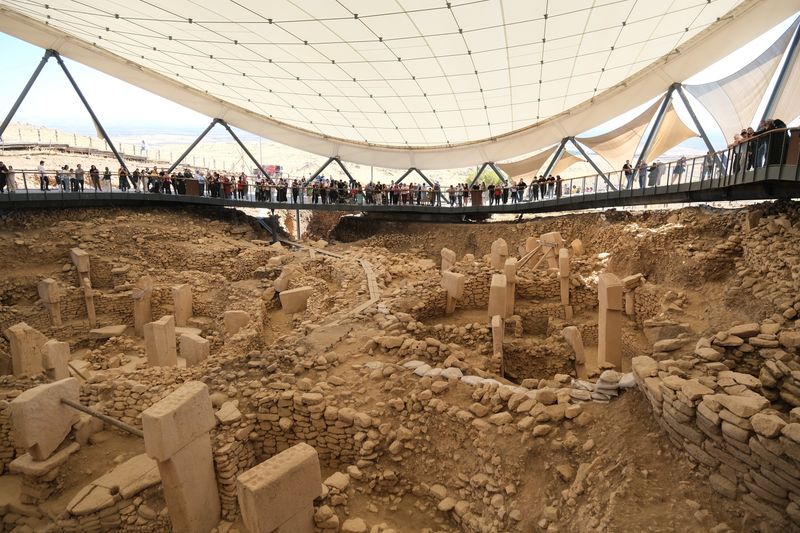
Mesopotamia had strong cultural and commercial relationships with Anatolia. The Taurus Mountains and the upper Tigris and Euphrates regions provided access to important resources, including metals, timber, and stone. Ancient trade networks connected southern Mesopotamian cities with settlements in southeastern Anatolia. One particularly important archaeological site is Göbekli Tepe, near Şanlıurfa in southeastern Turkey. Dating mainly to the Pre-Pottery Neolithic period, around the 10th millennium BC, Göbekli Tepe predates the emergence of Sumerian urban civilization by several thousand years. It is not a Mesopotamian city in the conventional sense, but it provides extraordinary evidence of complex communal and ritual activities among prehistoric communities in the broader region. Other important archaeological locations in southeastern Turkey include: Karahantepe: A remarkable prehistoric settlement associated with the Taş Tepeler archaeological landscape. Harran: An ancient settlement with a long history of cultural exchange between northern Mesopotamia and Anatolia. Dara: An important late Roman and Byzantine frontier city in Upper Mesopotamia. Zerzevan Castle: A Roman military settlement located on an important ancient route in southeastern Anatolia. These places help visitors understand the long historical connections between Anatolia and Mesopotamia.
11. The Legacy of Ancient Mesopotamia
Mesopotamia's importance extends far beyond its ancient empires. Many elements of modern civilization have roots in developments that took place in this region. Its historical contributions include: The development of one of the world's earliest writing systems. The emergence of large urban settlements. The establishment of organized government and administration. Early written legal traditions. Advances in mathematics and astronomy. Monumental religious architecture. The development of literature and historical record-keeping. Long-distance trade and diplomatic relations. Although the political powers of ancient Mesopotamia eventually disappeared, their intellectual and cultural achievements continued to influence later societies.
The Land That Changed Human History
Ancient Mesopotamia was much more than a collection of forgotten cities and vanished empires. It was one of the great laboratories of human civilization. From the first Sumerian cities and the invention of cuneiform writing to the imperial ambitions of Assyria and the monumental beauty of Babylon, this region transformed how human societies organized themselves. Its achievements in writing, mathematics, law, architecture, literature, and astronomy remain essential chapters in the story of humanity. Today, the archaeological remains of Mesopotamia, particularly in modern Iraq, Syria, and southeastern Turkey, offer an extraordinary opportunity to explore the origins of urban life and the development of the ancient world. To understand the history of civilization, one must begin with Mesopotamia — the land between the Tigris and Euphrates, where some of humanity's earliest great cities were born.
Last Modification : 11/5/2026 1:04:22 PM